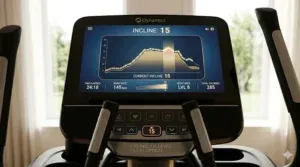
Stop Watching the Calorie Counter: The Console Metrics That Actually Predict Progress

Photo: Hikaru Iwasaki, Public domain, via Wikimedia Commons
You've done the work. Three or four sessions a week for the past few months, feet clipping along on the pedals, eyes locked on that little screen telling you 312 calories burned. And yet... nothing's changed much. Before you blame your metabolism or start shopping for a new machine, consider this: you might be training by the wrong numbers entirely.
We spend a lot of time at Elliptical Reviews testing consoles, and here's an uncomfortable truth we've learned: most of the metrics on your display are estimates dressed up as data. But a few of them are genuinely useful — if you know which ones to trust.
The Numbers That Are Lying to You
Let's start with the offenders.
Calories burned is the biggest culprit. Your elliptical console has no idea what your body is doing. It's running a formula based on your weight (if you even entered it), your speed, and a generous assumption about your effort. Studies on exercise equipment accuracy have found consoles can overestimate calorie burn by 20% or more — sometimes far more. And since ellipticals are low-impact and partially supported by your arms and the machine itself, the overestimate tends to run even higher than on a treadmill.
Distance is arguably worse, because it's not even pretending to measure anything real. There is no mile. Your elliptical invented that mile. If you covered 2.5 miles today, that number is a function of stride count and whatever math the programmer chose. It's useful for comparing Tuesday to Tuesday on the same machine, and useless for anything else.
Speed falls into the same bucket. Fast legs on low resistance can mean far less than slow legs grinding uphill.
So what's left?
The Two Metrics Worth Your Attention
Heart rate is the closest thing to an honest report card your body gives you. It doesn't care how fast your legs move — it reflects the actual physiological cost of what you're doing. A cheap chest strap will read more accurately than any console grip sensor, but even the metal pads on your machine's handles can get you in the ballpark if you hold them steadily.
For context, a simple estimate for max heart rate is 220 minus your age. Your moderate "fat-burn" zone sits around 60-70% of that max, while high-intensity work pushes you past 85%.
Resistance level is the other honest number. Unlike calories or distance, resistance is a real setting — the machine knows exactly what it's asking from you. If you log your resistance levels and how long you can sustain them, you're tracking genuine strength and endurance progress. Last month you could hold level 8 for ten minutes? This month you're holding level 10. That's not an estimate. That's data.
Three Workouts Built on Honest Numbers
Here's how to put those two metrics to work. Adjust resistance levels to fit your machine — budget models run lower numbers, premium ones go higher.
The Fat-Burn Zone Session (30 minutes)
Warm up five minutes at easy resistance. Then settle into a pace that keeps your heart rate at 60-70% of max — conversational, you could chat in full sentences. Hold it for 20 minutes at a moderate resistance you can sustain without white-knuckling the handles. Cool down for five. Boring? A little. Effective for building your aerobic base and teaching your body to use fat as fuel? Yes.
The HIIT Interval Session (20 minutes)
Warm up four minutes. Then alternate: 30 seconds at maximum sustainable resistance and cadence (aim for 85-90% of max heart rate by your final intervals), followed by 90 seconds of easy spinning at low resistance. Repeat that cycle eight times. Cool down for three minutes. This is the workout that most efficiently improves cardiovascular fitness in the least time — and it's nearly impossible to do by watching a calorie counter. Watch the clock and your heart rate instead.
The Endurance Builder (40 minutes)
Warm up five minutes. Pick a resistance level you can hold for 30 straight minutes with your heart rate sitting at 70-75% of max. The catch: every five minutes, bump the resistance up one level and hold. You should finish the final stretch at a level that felt impossible when you started. Over weeks, track where you start and how far you climb. That climbing ladder is your real progress report.
A Quick Word on Console Heart Rate Sensors
Grip sensors have a known weakness: they lag. Your heart rate changes over 10-15 seconds, and the pads take a while to catch up. During HIIT intervals, they'll mostly show you where you were, not where you are. If heart rate training becomes your thing, a $30 Bluetooth chest strap paired with your phone or a compatible console solves that problem entirely.
The Bottom Line
Your elliptical's calorie readout is a party trick. Distance is a fiction. But heart rate tells you what your body is actually spending, and resistance levels tell you what you're actually capable of — and whether that capability is growing. Train by those two numbers, log them for a month, and you'll have a clearer picture of your fitness than any 312-calorie readout ever gave you.
The machine you own is probably fine. The numbers you're watching probably aren't.