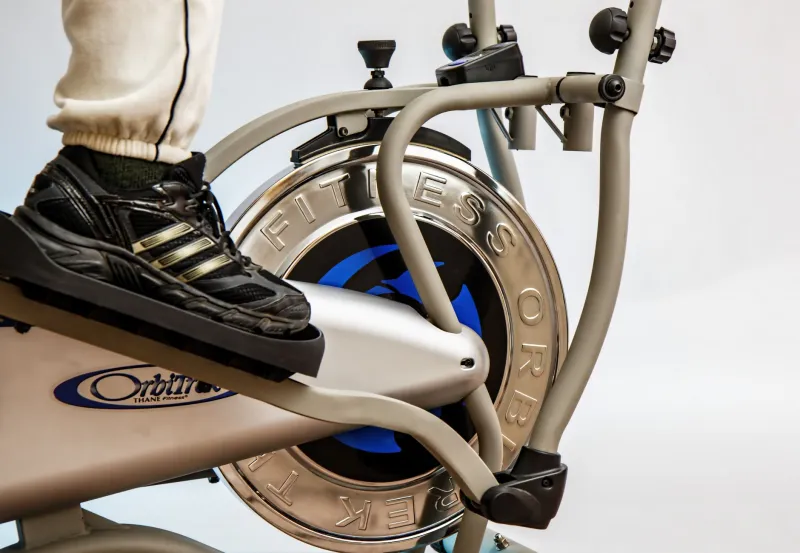
Built in the Clinton Era, Still Going Strong: What Decades-Old Ellipticals Teach Us About Buying Today
Every so often we get an email that stops us mid-scroll. This one came from a woman in Dayton, Ohio, whose mother has been stepping onto the same Precor elliptical every morning since 1997. That's roughly 10,000 workouts on a machine that predates the iPhone by a decade. It got us wondering: are these survivors flukes, or do they reveal something the fitness industry would rather we not notice?
The Rehab Unit That Never Retires
Start with hospitals and physical therapy clinics, because they're the harshest proving ground in the business. A rehab elliptical gets used by dozens of people a day, seven days a week, by bodies that can't afford a machine that lurches or seizes mid-stride.
Talk to clinic techs and a pattern emerges. Units from brands like Precor, Life Fitness, and Star Trac routinely hit 15 to 20 years of service with nothing more than ramp wheels, bearings, and the occasional console swap. These machines are heavy — 200-plus pounds of welded steel — and that weight is the point. A substantial frame doesn't flex, a flexing frame doesn't stress joints, and unstressed joints don't loosen bolts.
The kicker? Many of those same components were user-serviceable. Open panels, standard tools, parts diagrams published right in the manual.
Grandma's Basement Gym
The home stories are just as telling. We found a man in Minnesota still using a 1980s cross-country ski machine-elliptical hybrid his father bought new. A woman in Texas whose 2003 Schwinn 438 has outlived two treadmills and one marriage, in that order. What do these machines share?
- Mechanical simplicity. No touchscreen, no subscription, no firmware. Just a magnetic or belt-driven flywheel and a cable.
- Overbuilt drivetrains. Manufacturers of that era assumed you'd service the machine, not replace it.
- Available parts. Because so many units sold, third-party repair shops still stock bearings and bushings.
One owner told us she replaced a $14 bushing after eighteen years. Her total lifetime repair bill: less than one month of a modern fitness app subscription.
So What Happened?
Here's the uncomfortable part. Compare those machines to what's on the shelf at your local big-box store today, and the differences aren't subtle.
Modern budget and mid-range ellipticals lean hard into plastic housings, proprietary parts, and — increasingly — software. When your resistance is app-controlled and your console is the product, a discontinued model can become a very heavy coat rack the day the company stops pushing updates. We've covered this phenomenon in our teardown reviews: some $300 machines hide frames we genuinely wouldn't trust past year three.
To be fair, it's not all decline. Today's commercial-grade machines are, pound for pound, smoother and more ergonomically refined than anything from 1995. The problem is the widening gap between the top and bottom of the market — and the fact that the $500 tier, where most Americans actually shop, has quietly shifted from 'buy it for life' to 'buy it for the warranty period.'
What the Survivors Teach Us
If you want a machine with a shot at the 20-year club in 2025, the old-timers point to a clear checklist:
- Weigh it before you buy it. Under 100 pounds for a full-size elliptical is a red flag. Steel density is the cheapest durability insurance there is.
- Favor magnetic resistance with few electronics. The fewer circuit boards between you and a workout, the fewer ways the machine can die.
- Check parts availability before purchase. Call or chat with the manufacturer and ask, plainly: 'Can I order replacement bearings and pedals in year eight?' Their answer tells you everything.
- Prefer brands with published service manuals. Companies that expect you to repair their products tend to build products worth repairing.
- Buy used commercial when the budget's tight. A ten-year-old gym-unit Precor, refurbished, will embarrass most new $800 machines.
The Bottom Line
The 40-year-old machines aren't magic. They're just the output of companies that assumed their customers would keep the product. Somewhere along the way, a big chunk of the industry flipped that assumption — and our basements filled with machines designed to be replaced rather than repaired.
The good news? A handful of manufacturers still build the old way, and they're not hard to identify once you know what to look for. Ask the parts question. Check the weight. Read the warranty's labor terms. Your future self, stepping onto the same machine in 2045, will thank you.