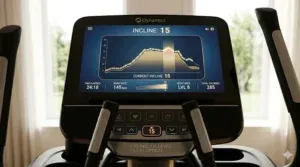
The 25-Degree Decision: Elliptical Indoors or a Walk in the Cold?

Photo: Erwin Bosman, CC0, via Wikimedia Commons
It's 6:40 a.m. in Minneapolis, the phone says 24 degrees, and the elliptical in the corner is looking awfully smug. You've got forty-five minutes before the day starts. Do you layer up and hit the sidewalk, or do you climb on the machine and get it over with?
We're not going to pretend there's one right answer, because there isn't. But the two activities are more different than most people assume — and the gap isn't where you'd expect.
The calorie math, without the marketing
Start with the numbers, because that's usually the first thing people want to know.
A 155-pound adult walking briskly at 3.5 mph on flat pavement burns somewhere in the neighborhood of 280 to 320 calories an hour. Put that same person on an elliptical at a moderate, conversational effort and you're looking at roughly 400 to 500 calories an hour — more if you're working the ramps and resistance.
So per minute, the machine wins. Except that's not how anyone actually exercises.
Most people will happily walk for 45 minutes outside. Many of those same people will stare down 18 minutes on an elliptical and start negotiating with themselves. A shorter, harder session isn't automatically the better session if you'd have done twice the work outdoors. And those console calorie readouts are generous at best — we've written before about how much guesswork is baked into them, so treat the delta as a rough shape rather than a precise ledger.
One more thing in the walk's favor: cold itself. Standing around shivering burns a little extra energy, and walking into a 15 mph headwind at 30 degrees adds real resistance. It's not a game-changer, but it's free.
| Elliptical | Winter walk | |
|---|---|---|
| Calories per minute | Higher | Lower |
| Typical session length | Shorter | Longer |
| Joint impact | Essentially none | Low but real |
| Bone-loading benefit | Almost none | Yes |
| Setup friction | Very low | Gear, weather, daylight |
| Risk of bailing entirely | High (boredom) | High (ice, dark) |
Your knees aren't the whole story
Elliptical defenders love the phrase zero impact, and it's basically true — your feet never leave the pedals, so there's no landing force to absorb. If you're rehabbing a cranky knee or coming back from a running injury, that matters.
But zero impact has a cost. Walking is weight-bearing, which means it sends a load signal through your hips and spine that your bones actually respond to. It also asks more of your balance, your ankles, and your hip extension than a fixed-plane machine ever will. Nobody's bones got denser from a year of elliptical-only cardio.
Walking also varies. Sidewalk cracks, curb cuts, a slight uphill, a dog that cuts across your path — all of that is low-grade stability work you don't get when your feet are locked into a track. If you're over 50, or you sit at a desk all day, that variety is worth something.
Motivation is a completely different animal outdoors
Here's the part the spreadsheets miss. A walk outside in daylight does things for mood and alertness that a basement session generally doesn't. In northern states, December sunsets land before 5 p.m., and for a lot of people that 20 minutes of outdoor light in the morning is the only real daylight they see on a workday.
On the other hand, outdoor walks have a failure mode the elliptical doesn't: a single sheet of black ice on your street can end the whole plan, sometimes painfully. And a 6 a.m. walk in January in Chicago is dark, cold, and — depending on your neighborhood — not always the safest bet.
The elliptical's superpower is availability. It's 71 degrees in the room, the floor is level, and the only thing that can stop you is your own boredom. That's not nothing. Consistency beats intensity over the long haul, and the machine that's always there wins a lot of weeks by default.
The gear tax nobody budgets for
A decent winter walking kit — insulated jacket, base layers, gloves that actually work, a reflective vest, traction cleats for your shoes — runs maybe $200 to $400 if you're starting from scratch. That's real money. It's still a fraction of a new elliptical, but if you already own the machine, the walk has a startup cost the elliptical doesn't.
Worth it? Usually yes, if only because a walk you can take anywhere is the most portable workout you'll ever own.
The hybrid plan we'd actually run
You don't have to choose, and you shouldn't. Try this shape for a winter week:
- Two outdoor walks, scheduled on the days with the best forecast and the most daylight. Aim for 35 to 50 minutes. Treat these as your bone-and-mood sessions.
- Two elliptical sessions, 20 to 25 minutes each, done as intervals — a hard two minutes, an easy two minutes, repeat. This is where you get the higher-intensity work without spending an hour staring at a wall.
- One long walk on the weekend, weather permitting, whenever it's above about 20 degrees and the sidewalks are clear.
Set your own cutoff line for wind chill and ice, write it down, and stop renegotiating it every morning. Ours is roughly 15 degrees with clear pavement. Below that, or after any freezing rain, the machine gets the nod and nobody feels bad about it.
The honest verdict
Is the elliptical better than a winter walk? Per minute of effort, yes. Per session, often no. For your bones and your head, mostly no. For showing up on a Tuesday in January when it's sleeting sideways, absolutely.
The machine isn't your competition. It's your backup plan that never flakes — and a backup plan you actually use is worth more than an ideal workout you skip.