What's Actually Braking Your Workout? A Buyer's Guide to Elliptical Resistance Systems

Photo: NASA; uploaded by User:Dipankan001., Public domain, via Wikimedia Commons
Ask someone why they returned an elliptical and you'll hear about wobbly pedals or a screen that died. Ask them why they stopped using one, and the answer is almost always the same: "It just started feeling off." That vague off-ness is usually the resistance system — the part of the machine nobody tests in the store because, frankly, nobody knows to.
Let's fix that before you spend a dime.
What Resistance Actually Does (And Why It's the Whole Ballgame)
The resistance system is what makes pedaling hard. That's it. But because it's always engaged — every stride, every workout — it shapes three things you'll live with for years: how smooth the motion feels, how much noise the machine makes, and how often you'll be tightening, lubricating, or replacing parts.
There are three main types you'll encounter at US retailers, and they cluster neatly by price tier.
Manual (Friction) Resistance: The Budget Baseline
Under $300, expect manual resistance. A felt or foam pad physically presses against the flywheel when you turn a knob. It works — resistance does increase — but the pad wears down, friction creates a faint hissing or rubbing sound, and the resistance levels are approximate at best. Crank it to 8 and you might get what felt like 6 last month, because the pad has compressed.
Is that a dealbreaker? For a casual user doing three light sessions a week, probably not. These machines are cheap precisely because the mechanism is simple. But if you're buying an elliptical expecting it to last through a real fitness journey, the friction pad is usually the first thing to fail — and pads aren't always easy to source for off-brand machines.
Magnetic Resistance: The Modern Default
From roughly $400 upward, you'll find magnetic resistance, and it's easy to see why it took over the market. Magnets hover near the flywheel without touching it. No contact means no friction, which means three big wins:
- Near-silent operation. This is the system behind every "quiet enough for a 5 AM apartment workout" claim you've ever read.
- Consistent levels. Dial in resistance 10 and it stays resistance 10, because magnets don't wear out like pads do.
- Minimal maintenance. There's essentially nothing to lubricate or replace.
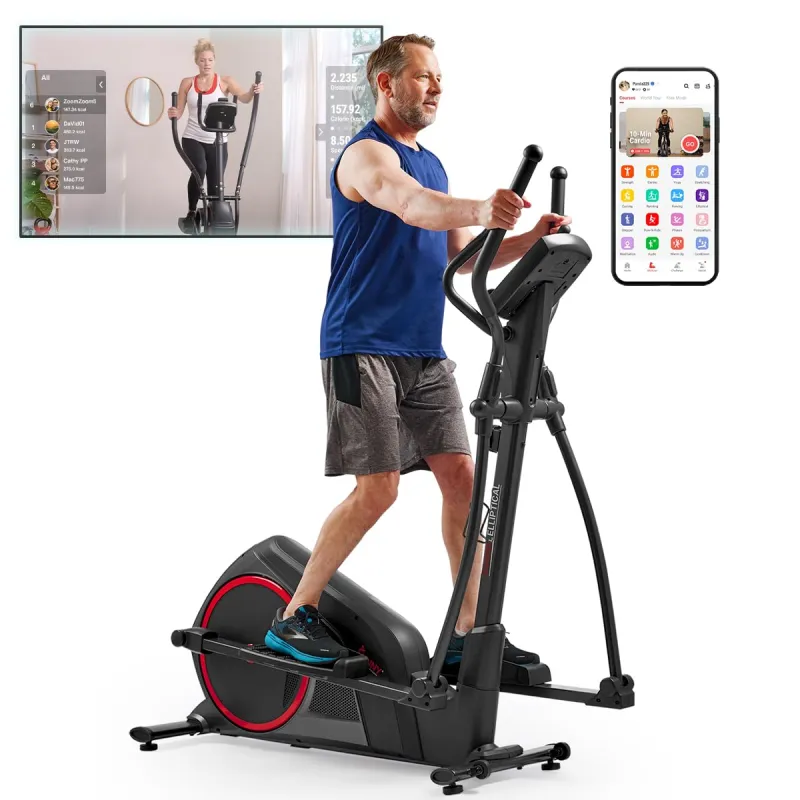
Most mid-range machines use either manual magnetic adjustment (a knob moving the magnet) or motorized magnetic adjustment (buttons on the console, often required for app-based workouts like iFIT or Peloton-style classes). If you want guided workouts that auto-adjust your resistance, motorized magnetic is the only option — a detail buried in fine print that frustrates a lot of buyers.
The tradeoff? Motorized systems add a servo motor, which is one more electronic component that can fail. It's rare, but it's the most common repair we hear about on machines in the $500–$1,000 range.
Air Resistance: The Niche Player
Air resistance uses a fan-style flywheel — the harder you go, the more air you push, the harder it gets. You'll see it on hybrid and studio-style machines. It's wonderfully self-regulating: no motors, no pads, and the resistance naturally matches your effort.
The catch is noise (that fan whirs, loudly) and less precise control. Air systems also pair poorly with small apartments and thin apartment walls. If you've got a garage gym and like to suffer, air is great. In a second-floor condo, it's a neighbor complaint generator.
The Three-Year Repair Math
Here's the breakdown we'd give a friend, based on typical ownership costs after three years of moderate use:
| System | Likely Repairs | Typical Cost |
|---|---|---|
| Manual friction | Pad replacement, knob cable | $20–$60 (if parts exist) |
| Manual magnetic | Rarely anything; maybe belt | $0–$40 |
| Motorized magnetic | Servo motor or console board | $80–$200 out of warranty |
| Air | Almost nothing mechanical | ~$0 |
Notice something? The cheapest machines often cost the most per year of usable life, because a worn pad on a no-name brand can total the whole unit. Meanwhile, a $700 magnetic machine with a solid frame warranty may need literally zero dollars in repairs over three years.
What to Check Before You Buy
- Look for the word "magnetic" in the specs. If the listing doesn't say, assume it's friction.
- Confirm motorized vs. manual adjustment if you plan to use app-based classes.
- Ask about parts availability. Big US brands (Schwinn, Sole, NordicTrack, Horizon) stock replacement parts for years. Amazon no-names often don't.
- Weigh the warranty against the system. A magnetic system under a good frame warranty is about as close to maintenance-free as home fitness gets.
The Bottom Line
If your budget stretches to a magnetic machine, stretch it. The silence, consistency, and near-zero upkeep are worth the extra $150–$300 over a friction model, and your future self — the one still actually using the machine in 2028 — will be glad you did. Manual resistance isn't a scam; it's just a rental car when what you really want is to buy the car.