The Ramp vs. The Dial: Why Cranking Incline and Cranking Resistance Are Two Totally Different Workouts
Stand in the elliptical aisle at any Dick's Sporting Goods or scroll through a Amazon listing for five minutes and you'll see it: two specs, both expressed in numbers, both promising a harder workout. Resistance and incline. Most shoppers lump them together as "making it tougher" and move on.
That's a costly mistake — sometimes a $400 one.
What Resistance Actually Does (And Doesn't Do)
Resistance is the brake. Whether it's magnetic or manual, turning it up makes the pedals harder to push. Your quads, glutes, and calves work harder against that brake, your heart rate climbs, and you burn more calories per minute. Simple.
But here's the catch: resistance doesn't change where the effort comes from. Your feet still travel the same oval path. Your hips, knees, and glutes stay in the exact same positions they were at level one. You're just asking the same muscles to push harder.
Think of it like riding a bike in one gear up a flat road versus another gear on the same flat road. Different effort, same muscles, same motion.
What Incline Actually Changes
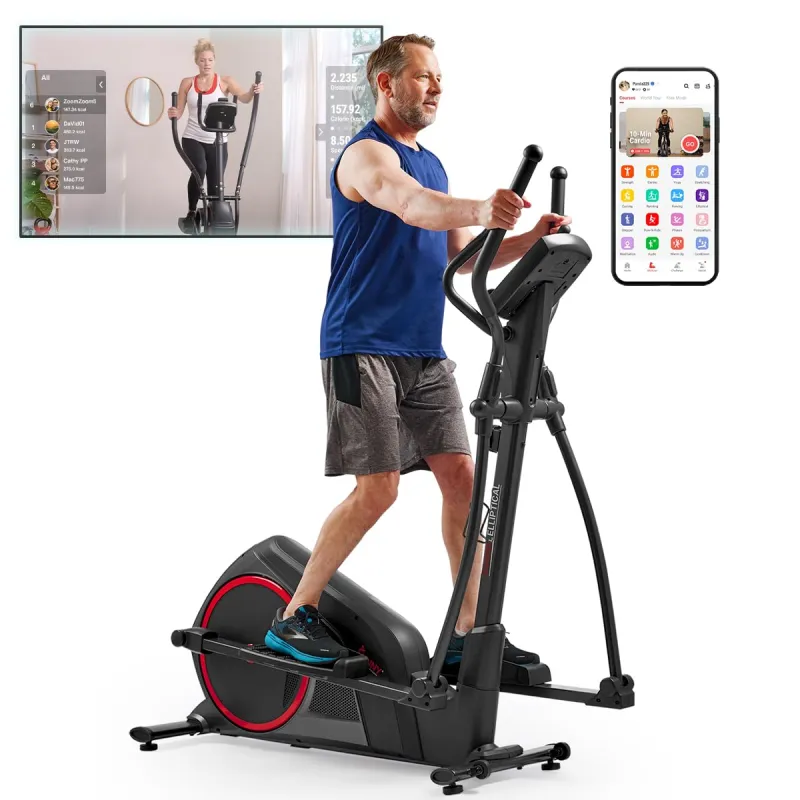
Incline is different. When the ramp tilts — or the pedal path steepens on machines with adjustable incline — the geometry of your stride changes. Your foot travels higher and lower through the ellipse, which means:
- Your glutes and hamstrings take over as the ramp climbs, mimicking a hill climb
- Your calves and quads work differently on the descent
- Your hips go through a bigger range of motion, which some people love and some people hate
This isn't marketing fluff. Biomechanics research on elliptical ramp height has consistently shown that steeper pedal paths shift muscle activation posteriorly — toward the backside. If you've ever finished a treadmill hill workout with sore glutes while flat runs never touched them, you already understand the concept. Incline applies it to the elliptical.
So: resistance makes the same workout harder. Incline makes it a different workout. Both raise your heart rate. Only one changes which muscles get the bill.
Who Actually Needs Powered Incline?
Honest answer: fewer people than the spec sheets want you to believe.
Skip incline if: you're primarily after cardio and calorie burn, you're cross-training for a sport, or you're rehabbing and want predictable, consistent motion. A solid resistance-only machine will serve you for years.
Consider incline if: you're targeting glutes and hamstrings (a common goal, let's be real), you get bored easily and need variety to stay consistent, or you're training for hiking, hill running, or skiing. The muscle-activation shift is real, and for those goals it matters.
What You Get at Each Price Point
Under $500: Powered incline is basically nonexistent here. You'll find manual ramp angles — a fixed slope baked into the frame. That's fine, but know that "16 levels of resistance, 5 levels of incline" on a $350 machine usually means five fixed positions you set with a pin, if the ramp adjusts at all. Machines like budget Sunny Health & Fitness models fall in this camp.
$500–$1,200: This is where motorized incline starts appearing, typically in the 0–20 degree range on machines like the NordicTrack models that dominate this bracket. Powered incline means you can change the ramp mid-workout via programmed routes — genuinely useful for interval training.
$1,200 and up: Full incline and decline ranges, heavier flywheels, and smoother ramp transitions. These machines essentially replicate outdoor terrain. Great, but only worth it if you'll actually use the programming.
One warning: incline adds a moving mechanism, and moving mechanisms add failure points. On cheap machines, the motorized ramp is often the first thing to go — usually right after the warranty does. If powered incline is a must-have, read the warranty's coverage of the incline motor specifically, not just "parts."
The Bottom Line
If your goal is general fitness, weight management, or low-impact cardio, spend your budget on a smoother flywheel and better build quality instead of a motorized ramp. A well-made resistance-only machine beats a wobbly incline-equipped one every time.
But if glute and hamstring development or terrain-style variety is your thing, incline isn't a gimmick — it's the only spec on the sticker that changes what you're training, not just how hard. Shop accordingly, and don't let the two numbers blur together.